A New Way of Designing Workspaces
The contemporary workplace design landscape is being rewritten. Contemporary office architecture now moves beyond efficiency and aesthetics toward environments that respond to people. Work today is fluid. Teams expand and contract. Attention shifts between focus and collaboration. Climate conditions intensify. In response, future-ready workplaces anticipate change rather than react to it. The question is no longer how an office looks on day one, but how it performs over time.
Climate Intelligence as Spatial Strategy
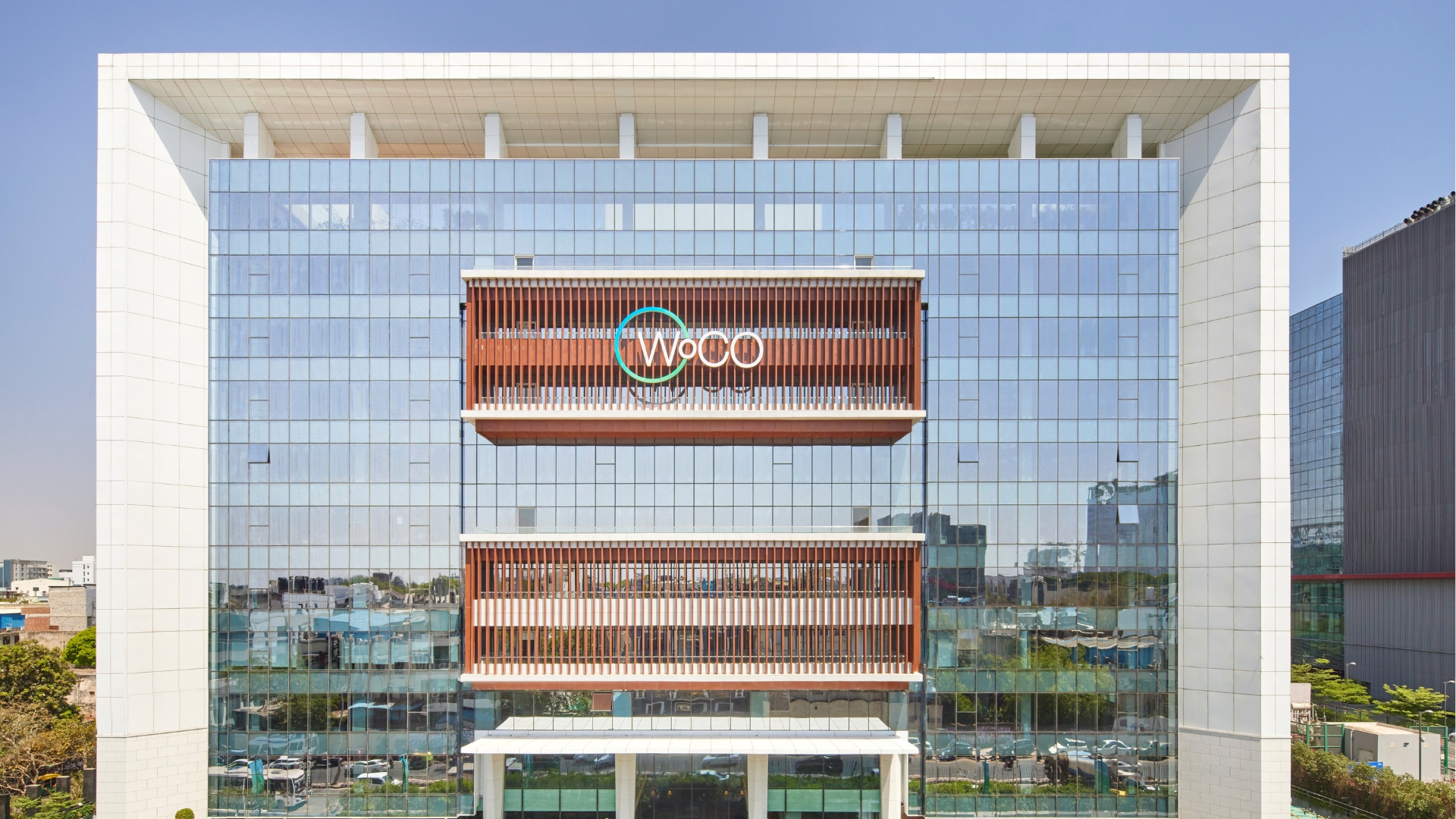
At WoCO One in Gurugram, climate-responsive design is embedded into the spatial experience. The southwest façade is shaped by vertical fins and trellis-guarded projections that filter harsh sunlight while allowing breeze to move through double-volume workspaces. Insulated glazing draws in daylight while mitigating glare and heat gain, reducing electrical load and creating visual comfort across expansive floor plates. Terraces and deep balconies extend work areas outward, turning shaded spill-out spaces into informal zones of pause. This is passive sustainability operating at the scale of everyday use.
Regional sensitivity extends beyond façades. Material choices, shaded landscapes, and layered plantations temper the microclimate and reduce the urban heat island effect. Rainwater harvesting and high-SRI roof finishes close resource loops. Such strategies demonstrate how sustainable office design can shape daily occupation. Comfort, legibility, and energy performance converge to support well-being and sustained attention.
Offices as Places to Learn
The workplace is increasingly a site of exchange. Through experiential planning, WoCO One uses double-height cut-outs, open floor plates, and a Sky Garden to create visual connections across levels. Observation becomes incidental learning. Movement through balconies, lounges, and recreational spill-outs generates moments of dialogue beyond scheduled meetings. The planning avoids rigid compartmentalisation, allowing collaboration to unfold organically.
At the Odisha Mining Corporation headquarters in Bhubaneshwar, Odisha, multiple bridges, terraces, food courts, and shared decks knit together three towers into a connected precinct. The 400-metre-long SkyDeck acts as a civic promenade as much as a corporate amenity. Informal gathering spaces and co-working provisions support evolving work cultures where knowledge flows across departments and institutions. The workplace becomes an ecosystem that balances concentration with exchange.
Designing for Change
Future teams are unpredictable. Flexible office interiors must absorb that uncertainty. WoCO One’s 17,000 sq. ft. open floor plates, decentralised service cores, and minimal structural interruptions allow tenants to reconfigure layouts without invasive interventions. Double-volume spaces can transform into duplex or triplex arrangements. Neutral palettes and modular systems ensure adaptability without major overhauls.
At OMC, adaptability is spatial and technological. A kinetic façade with sensor-controlled louvres regulates daylight and glare in real time, exemplifying adaptive architecture. Provisions for co-working towers and commercial programmes anticipate organisational growth and shifting work models. This layered flexibility defines the future of workplace design.
Towards Workplaces That Endure
Resilient offices are shaped by foresight. By combining climate-responsive architecture, flexible planning, and spaces that encourage informal learning, contemporary offices remain relevant over time. When architecture understands that work itself is evolving, it creates workplaces that are adaptable, engaging, and aligned with human behaviour.
As architectural boundaries continue to be pushed, luxury housing in India will undoubtedly remain at the forefront of architectural innovation, offering residents a life of unmatched luxe and style while enabling community living.